Interactive GeoGebra media embedded in student worksheets: a design approach to foster mathematical engagement in 3D Geometry
DOI:
https://doi.org/10.33830/ijdmde.v2i2.11362Keywords:
three-dimensional, geometry, Geogebra, mathematics interest, MediaAbstract
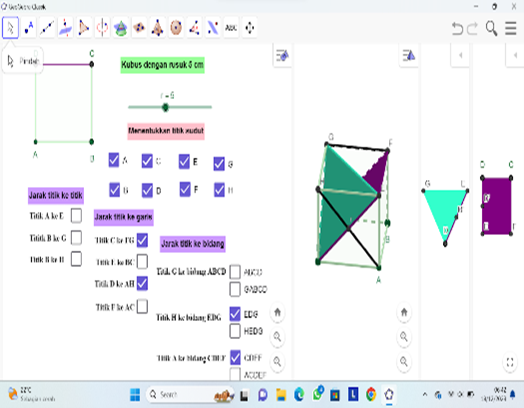
Geometry, particularly three-dimensional (3D) geometry, is often perceived by students as abstract and difficult, resulting in low engagement and interest. Addressing this issue, the present study aimed to design interactive learning media using GeoGebra integrated with Student Worksheets to enhance students’ interest in learning 3D geometry. The research employed a Research and Development (R&D) methodology, encompassing the stages of needs analysis, design, development, implementation, and evaluation. The participants were 30 students from a public high school in Cianjur, Indonesia, who were involved in mathematics instruction on 3D geometry topics. Data were collected through student response questionnaires assessing the usability and effectiveness of the developed media. The findings indicate that the GeoGebra-based Student Worksheet media met validity and practicality criteria, with students responding positively to its use. They reported that the interactive features of the media facilitated better conceptual visualization and significantly increased their interest in learning. Furthermore, implementation strategies—such as teacher demonstrations, collaborative group work, and guided class discussions—proved effective in mitigating the abstractness of 3D geometry. This research contributes to the growing body of literature on technology-enhanced mathematics instruction by offering a practical and engaging learning solution. The integration of GeoGebra-based Student Worksheets is therefore recommended as an effective pedagogical tool to foster students’ mathematical interest and conceptual understanding, especially in abstract topics like three-dimensional geometry.
References
Alghadari, F., Herman, T., & Prabawanto, S. (2020). Factors affecting senior high school students to solve three-dimensional geometry problems. International Electronic Journal of Mathematics Education, 15(3), em0590. https://doi.org/10.29333/iejme/8234
Ansari, B. I., Sulastri, R., & Apriana, E. (2019). The development of mathematics higher order thinking learning using metacognitive strategies in term of model effectiveness. Journal of Modern Education, 9(3), 218–229. https://doi.org/10.15341/jmer(2155-7993)/03.09.2019/010
Basri, H., García-García, J., Rodríguez-Nieto, C. A., Rifanda, A. R., & Indahwati, R. (2025). GeoGebra-Assisted discovery learning: an effective strategy to enhance elementary students’ interest in learning plane area measurement. International Journal of Didactic Mathematics in Distance Education, 2(1), 1–15. https://doi.org/10.33830/ijdmde.v2i1.11272
Buckley, J., Seery, N., & Canty, D. (2019). Investigating the use of spatial reasoning strategies in geometric problem solving. International Journal of Technology and Design Education, 29(2), 341-362. https://doi.org/10.1007/s10798-018-9446-3
Fadaee, B., & Ghahramani, H. (2021). Investigating the impact of several factors (interest, educational tools, teaching methods) on learning geometry. Research in Mathematics Education, 2(2), 47–55.
Fatihah, J. J., Sudirman, S., & Mellawaty, M. (2023). Improving geometric thinking skills through learning cycles assisted by interactive geometry books. International Journal of Mathematics and Sciences Education, 1(2), 81–85. https://doi.org/10.59965/ijmsed.v1i2.74
Gurmu, F., Tuge, C., & Hunde, A. B. (2024). Effects of GeoGebra-assisted instructional methods on students’ conceptual understanding of geometry. Cogent Education, 11(1), 2379745. https://doi.org/10.1080/2331186X.2024.2379745
Hartati, P., Susanta, A., & Yensi, N. A. (2024). Errors in Solving Distance Material on Spatial Figures: Analytical Study on High School Students of Bengkulu Tengah. International Journal of Contemporary Studies in Education (IJ-CSE), 3(3), 269–277.
Hidayat, R., Noor, W. N. W. M., Nasir, N., & Ayub, A. F. M. (2024). The role of GeoGebra software in conceptual understanding and engagement among secondary school student. Infinity Journal, 13(2), 317-332. https://orcid.org/0000-0002-7962-0194
Huckstep, P. (2003). Issues in the teaching and learning of arithmetic. In Aspects of Teaching Secondary Mathematics: Perspectives on Practice (pp. 91–104). Routledge. https://doi.org/10.4324/9780203165874-12
Hwang, W. Y., & Hu, S. S. (2013). Analysis of peer learning behaviors using multiple representations in virtual reality and their impacts on geometry problem solving. Computers & Education, 62, 308-319.
Korenova, L. (2017). GeoGebra in teaching of primary school mathematics. International Journal for Technology in Mathematics Education, 24(3), 155-160. https://doi.org/10.1564/tme_v24.3.08
Lavicza, Z., Abar, C. A. A. P., & Tejera, M. (2023). Spatial geometric thinking and its articulation with the visualization and manipulation of objects in 3D. Educação Matemática Pesquisa Revista Do Programa de Estudos Pós-Graduados Em Educação Matemática, 25(2), 258–277. https://doi.org/10.23925/1983-3156.2023v25i2p258-277
Lestari, A., Maulana, Z. W., Fauziah, N. M., Fauztina, T. H., Indah, R., Ishartono, N., & Zulnaidi, H. (2025). Development of GeoGebra-based mathematics learning media integrated with investigative questions on cubes material. AIP Conference Proceedings, 3142(1).
Pratama, M. R., Sugiarni, R., & Faizun, A. (2024). Development of learning media uses geogebra application with basket ball context on square function material. Proceeding of The International Conference of Inovation, Science, Technology, Education, Children, and Health, 4(1), 140–152.
Radović, S., Radojičić, M., Veljković, K., & Marić, M. (2020). Examining the effects of Geogebra applets on mathematics learning using interactive mathematics textbook. Interactive Learning Environments, 28(1), 32-49. https://doi.org/10.1080/10494820.2018.1512001
Septian, A., Suwarman, R. F., Monariska, E., & Sugiarni, R. (2020). Somatic, auditory, visualization, intellectually learning assisted by GeoGebra to improve student’s mathematical representation skills. Journal of Physics: Conference Series, 1657(1), 12023. https://doi.org/10.1088/1742-6596/1657/1/012023
Suciati, R. A., Sobarningsih, N., Sugilar, H., Farlina, E., & Juariah. (2023). Students’ error analysis in solving three dimensional problems in terms of spatial ability. AIP Conference Proceedings, 2572(1). https://doi.org/10.1063/5.0119743
Sudirman, S., Kusumah, Y. S., Martadiputra, B. A. P., & Runisah, R. (2023). Epistemological obstacle in 3D geometry thinking: Representation, spatial structuring, and measurement. Pegem Journal of Education and Instruction, 13(4), 292-301. https://doi.org/10.47750/pegegog.13.04.34
Sugiarni, R., Alghifari, E., & Ifanda, A. R. (2018). Meningkatkan kemampuan spasial matematis siswa dengan model pembelajaran problem based learning berbantuan Geogebra. KALAMATIKA Jurnal Pendidikan Matematika, 3(1), 93–102. https://doi.org/10.22236/kalamatika.vol3no1.2018pp93-102
Sugiarni, R., Aulia, S. H., & Butar, A. M. (2024). Development of visual media uses geogebra application on linear program material. Proceeding of The International Conference of Inovation, Science, Technology, Education, Children, and Health, 4(1), 153–163.
Sugiarni, R., Inayah, S., & Suwarman, R. F. (2019). Student worksheets for E-learning models based on environmental projects on geometry topics in spreading literacy culture. In International Journal of Scientific and Technology Research (Vol. 8, Issue 10, pp. 418–422).
Uwurukundo, M. S., Maniraho, J. F., Tusiime, M., Ndayambaje, I., & Mutarutinya, V. (2024). GeoGebra software in teaching and learning geometry of 3 Dimension to improve students’ performance and attitude of secondary school teachers and students. Education and Information Technologies, 29(8), 10201–10223. https://doi.org/10.1007/s10639-023-12200-x
Wassie, Y. A., & Zergaw, G. A. (2019). Some of the potential affordances, challenges and limitations of using GeoGebra in mathematics education. Eurasia Journal of Mathematics, Science and Technology Education, 15(8), em1734. https://doi.org/10.29333/ejmste/108436
Widyastiti, M., Yanti, Y., Sumarsa, A., & Durrotul Faizah, L. (2024). Utilization of Geogebra application as learning media in learning the three-dimensional to increase students’ interest in learning. Hipotenusa: Journal of Mathematical Society, 6(1), 1–11. https://doi.org/10.18326/hipotenusa.v6i1.815
Yerizon, S. F., Tasman, F., & Tasman, F. (2021). Development of a geogebra-assisted calculus worksheet to enhance students’ understanding. International Journal of Information and Education Technology, 11(10), 456-463.
Zhang, Y., Wang, P., Jia, W., Zhang, A., & Chen, G. (2023). Dynamic visualization by GeoGebra for mathematics learning: a meta-analysis of 20 years of research. Journal of Research on Technology in Education, 1–22. https://doi.org/10.1080/15391523.2023.2250886
Zhang, Y., Wang, P., Jia, W., Zhang, A., & Chen, G. (2025). Dynamic visualization by GeoGebra for mathematics learning: a meta-analysis of 20 years of research. Journal of Research on Technology in Education, 57(2), 437-458. https://doi.org/10.1080/15391523.2023.2250886
Zulnaidi, H., & Zamri, S. N. A. S. (2017). The effectiveness of the GeoGebra software: The intermediary role of procedural knowledge on students’ conceptual knowledge and their achievement in mathematics. Eurasia Journal of Mathematics, Science and Technology Education, 13(6), 2155-2180. https://doi.org/10.12973/eurasia.2017.01219a
Downloads
Published
How to Cite
Issue
Section
License
Copyright (c) 2025 Rani Sugiarni, Pitri Aulia, Novi Suryadini, Ebenezer Bonyah, Ronaldo Rafael Olivero-Acuña

This work is licensed under a Creative Commons Attribution-ShareAlike 4.0 International License.